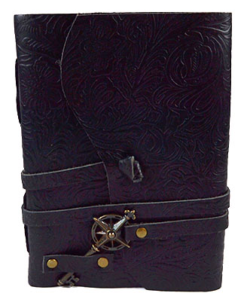
Embossed Key Leather Journal with Latch
$40.65
A Real Key On The Cover
An embossed leather journal with a real metal key set into the front, aged parchment pages with rough edges and a latch closure, built to hold the knowledge you keep locked away.
Quick Uses
- Private grimoire: Keep the workings no one else is meant to read.
- Crossroads book: Record crossroads rites and Hecate devotions.
- Opening rite: Touch the key before writing as a sign of opening the book.
- Seal book: Draw seals of the spirits you work with.
How to Use It
Witchcraft & Folk Magick
- Record moon phases, herb correspondences and the recipes that worked, so the book grows into your own tradition.
- Copy each spell out by hand before you cast it; writing it is part of charging it.
Ceremonial & Occult Magick
- Use it as a magickal record: date, planetary hour, rite performed and what you saw.
- Write out invocations and circle-casting texts so the book itself can be carried into the temple.
Demonology & Black Magick
- Treat the key as the book’s lock in spirit: touch it to open each session and again to close it, and write nothing you would not keep sealed.
- Design and refine sigils on its pages, and draw each spirit’s seal before an evocation.
- Record dreams, visions and the events of each evocation straight after the rite, while they are fresh.
A Simple Working
- At a crossroads or a three-way path, or at your altar facing it, light a black candle.
- Burn a little myrrh or garlic skin as an offering to Hecate.
- Lay your hand on the key on the cover.
- Ask Hecate the keybearer to guard the book.
- Write her name and the date on the first page.
- Leave the remains of the offering at the crossroads and close the latch.
Pairs Well With
- Myrrh: A traditional offering to Hecate.
- Black chime candles: For crossroads dedications.
- Skeleton key charms: For key magick inside the book.
- Dragon’s blood ink: For seals and sigils.
What You Receive
One embossed leather journal with a real metal key embedded on the front cover, aged parchment-style pages with rough edges and a latch closure.
Origin & Lore
Keys have long stood for access to hidden knowledge and to other worlds. A keyed book is a classic image for a grimoire: a book that opens only to its owner.
Aged parchment with rough edges gives it the look of the handwritten books of the art.
Did You Know?
Hecate was called Kleidouchos, the key-holder, in Greek religion, and her statues often show her carrying a key.
| Weight | 1.2 lbs |
|---|
Related products


All Journals