


Frankincense rises bright and myrrh lies low and dark, and burned together they make the incense of the Nativity.
Origin & Traditional Use
Frankincense and myrrh are both resins of trees of southern Arabia and the Horn of Africa, traded together for thousands of years and burned together in temples and churches. Their pairing comes from the Magi’s gifts in the Gospel of Matthew, and it remains the most traditional blend in Christian worship.
Uses by Tradition
Witchcraft & Folk Magick
- Blessing: burn when setting up a new altar or consecrating a sacred space.
- Devotion: burn as a daily offering before images of deities, saints or ancestors.
- Purification: burn before ritual to cleanse and settle the room.
Ceremonial & Occult Magick
- Consecration: pass tools, talismans and robes through the smoke before first use.
- Opening and closing: burn at the start and end of a ritual to mark sacred time.
A Simple Working
- Set a white candle in a holder on your altar.
- Light the candle and light a frankincense and myrrh stick from it.
- Wave the smoke over the altar in a cross or a circle.
- Say a short blessing in your own words.
- Set the stick in a holder beside the candle.
- Let both burn out, and keep the altar clear of clutter until the next working.
Pairs Well With
- A white chime candle: for blessing and devotion.
- Charcoal tablets: for burning loose frankincense and myrrh resin.
- Holy water: the traditional companion in a blessing.
- An incense holder: to catch the ash.
Lore & History
Around 1470 BCE, Queen Hatshepsut of Egypt sent an expedition to the Land of Punt that brought back incense trees, sacks of resin and other treasures; the voyage is carved in reliefs on her temple at Deir el-Bahari. It is one of the earliest recorded attempts to transplant incense trees.
What You Receive
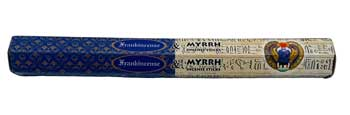
Frankincense and myrrh incense sticks, available in a 20 pack, a 20 pack (pure) or a 16 pack.
Did You Know?
Both resins are harvested by tapping: shallow cuts are made in the bark, and the sap that seeps out is left to harden into ‘tears’ before collection.
| Weight | N/A |
|---|---|
| Option | 20 pack, 20 pack (pure), 16 pack |
Related products


