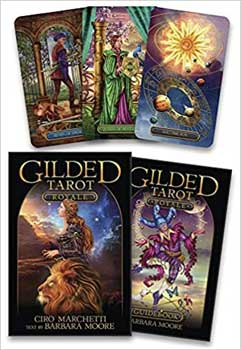
Gilded Tarot Royale (Deck & Book) by Marchetti & Moore
$35.19
Gold-Lit Classical Tarot
A full 78-card tarot steeped in classical, occult and medieval imagery, chosen by readers who want a deck that feels like an heirloom on the altar.
Quick Uses
- Daily Draw: Pull one card each morning and note how its image plays out by nightfall.
- Pre-Ritual Reading: Lay a three-card spread before any working to read the conditions you are stepping into.
- Altar Focus: Stand a chosen trump against your candle as the visual anchor of a spell.
- Study: Work through the guidebook one card a night to build a personal vocabulary of meanings.
How to Use It
Witchcraft & Folk Magick
- Choose the card that matches your goal (the Sun for success, the Star for hope) and set it beneath a spell candle.
- Read at the turn of each moon phase to track how a long working is unfolding.
Ceremonial & Occult Magick
- Use the trumps as gateways for pathworking: gaze into a card, then visualise stepping through its frame.
- Assign the suits to the four elemental quarters and lay the aces at the cardinal points of your circle.
Demonology & Black Magick
- Read before an evocation to ask whether the time is right, and again afterward to check what answered.
- Ask a spirit you already work with to speak through a single drawn card, and record its reply in your grimoire.
- Lay a chosen card under a black candle as the focal image of a binding or banishing working.
A Simple Working
- Clear your table and light a white chime candle with a pinch of frankincense on charcoal.
- Shuffle the deck while stating the question aloud, plainly and once.
- Draw three cards: the root of the matter, what stands in the way, and the likely course.
- Read each card first by its image, then check the guidebook for anything you missed.
- Write the spread and your reading in a dated journal entry.
- Let the candle burn down and return the cards to their box.
Pairs Well With
- Black altar cloth: gives the gilded art a clean dark field to read against.
- Frankincense resin: a traditional smoke for clearing a deck before first use.
- Clear quartz point: kept on top of the stored deck to hold it ready between readings.
- Blank grimoire: a place to log spreads and watch patterns emerge over months.
What You Receive
One tarot deck of 78 cards with a 168-page guidebook.
Origin & Lore
Tarot began in fifteenth-century Italy as a card game, the trionfi, played with an added suit of picture trumps. Its use for divination grew in France in the late eighteenth century, and occultists of the nineteenth century tied the trumps to Hebrew letters, astrology and the elements.
This deck draws on that inheritance with classical and medieval imagery and rich gold detailing, making it a natural fit for ritual readers who like a formal, ceremonial look.
Did You Know?
The oldest surviving tarot cards are the hand-painted Visconti-Sforza decks of mid-fifteenth-century Milan, made for the ruling families and decorated with real gold leaf.
| Weight | 1.4 lbs |
|---|
Related products


Crystal Balls