

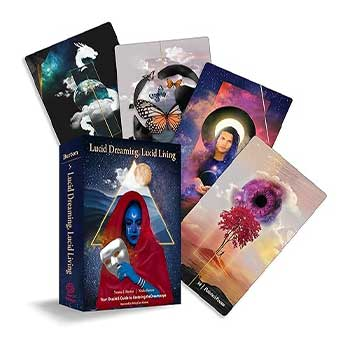
Lucid Dreaming, Lucid Living Oracle (Deck & Book) by Burton & Burton
$32.95
Oracle For Lucid Dreamers
A 44-card oracle for exploring states of consciousness and navigating dream worlds, used by practitioners of lucid dreaming and astral work.
Quick Uses
- Bedtime Draw: Pull a card before sleep and set it as the theme you intend to dream into.
- Dream Interpretation: Draw a card in the morning to shed light on a confusing dream.
- Lucidity Practice: Use the cards’ images as dream signs to recognise when you are dreaming.
- Daily Guidance: Read a card for a waking-life problem the way you would read a dream.
How to Use It
Witchcraft & Folk Magick
- Keep a drawn card under the pillow with a sachet of mugwort for dream work.
- Read at the full moon, traditionally a strong night for dreams.
Ceremonial & Occult Magick
- Use a card as the focus for an astral projection exercise, visualising stepping into its scene.
- Pair a bedtime card with a short banishing ritual so you enter sleep in a cleared space.
Demonology & Black Magick
- Ask a spirit to meet you in a dream, drawing a card as the image of your meeting place.
- Read in the morning to understand what visited you in the night, and record it in your evocation log.
- Use the deck to choose a symbol or sigil to hold in mind while falling asleep for dream contact.
A Simple Working
- Before bed, burn a little mugwort and let the smoke clear the bedroom.
- Light a small white candle and shuffle the deck slowly.
- Draw one card and study it until you can picture it with eyes closed.
- State aloud that you will see this image in your dream and know you are dreaming.
- Snuff the candle and place the card face up on the nightstand.
- On waking, write every dream down before you get up, and look for the card’s image.
Pairs Well With
- Mugwort: the best-known herb for vivid dreams.
- Dream pillow: a herb-filled pillow to support dream work.
- Amethyst: a stone often kept by the bed for dreams.
- Dream journal: essential for tracking lucid dreams.
What You Receive
One oracle deck of 44 full-colour cards with a 200-page guidebook.
Origin & Lore
Oracle decks are built around a theme rather than tarot’s fixed structure. This one is built around lucid dreaming, the state of knowing you are dreaming while still in the dream, and offers images and text to help dreamers move through different states of consciousness.
Dream incubation is ancient: in the Greek world the sick slept in the temples of Asclepius hoping for a healing dream, and Tibetan Buddhists have long practised dream yoga to stay aware through sleep.
Did You Know?
The term ‘lucid dream’ was coined by the Dutch psychiatrist Frederik van Eeden in a 1913 paper describing hundreds of his own dreams.
| Weight | 1.9 lbs |
|---|
Related products



Crystal Balls