

Macabre Tarot by Sam Rock
$38.45
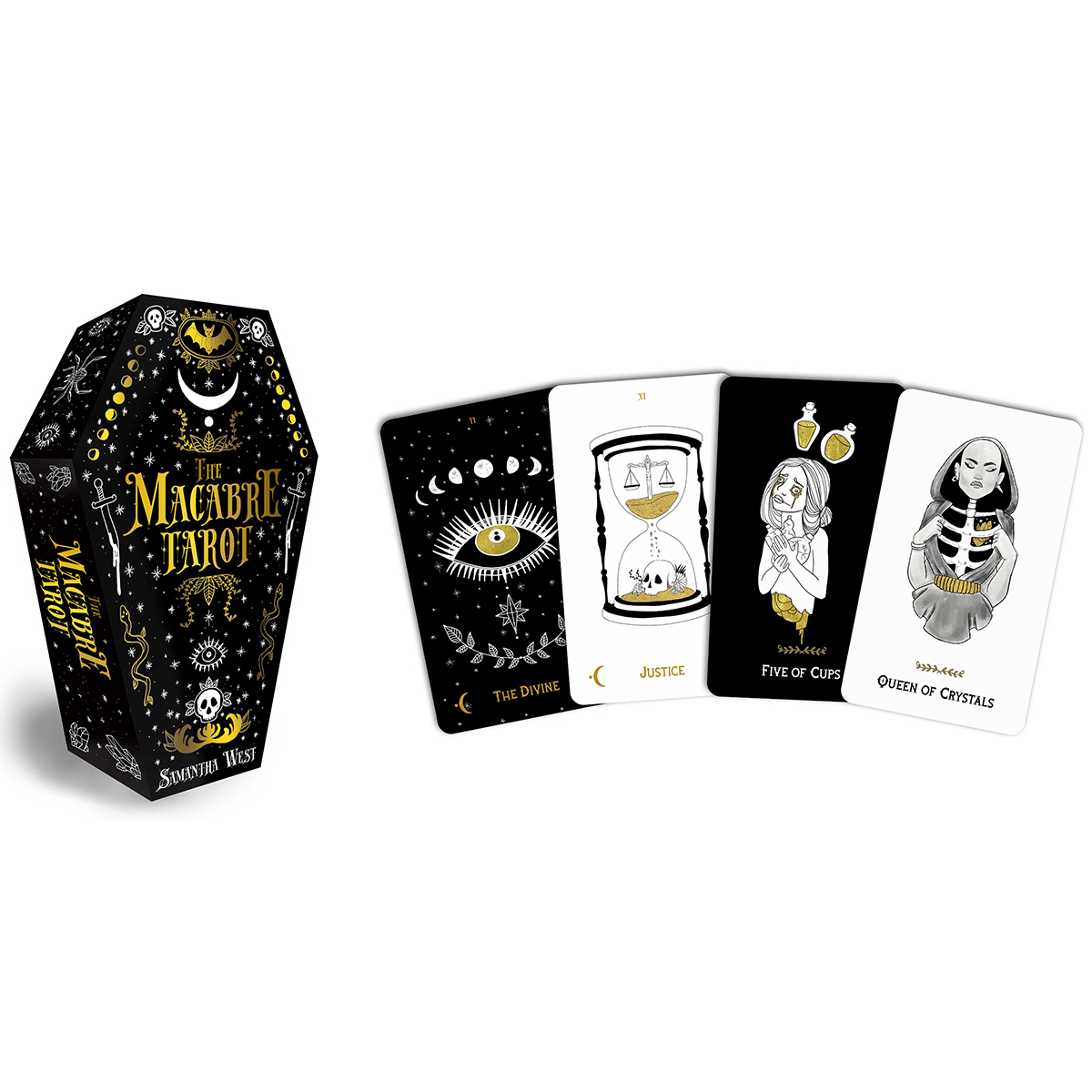
Shadow Tarot In A Coffin
A 78-card tarot in black, white and gold that reads every card from its darker side, kept in a coffin box by readers who prefer their divination unsoftened.
Quick Uses
- Shadow Reading: Ask what fear is steering you and read the card without flinching.
- Dark Moon Divination: Lay a spread on the dark moon, when the deck’s mood suits the sky.
- Hex Focus: Lay a card as the image at the centre of a curse or binding.
- Altar Piece: Keep the coffin box on a necromantic altar between readings.
How to Use It
Witchcraft & Folk Magick
- Read on the dark moon or at Samhain to ask what must die before something new can grow.
- Set a card under a black candle in a banishing working to name what you are casting out.
Ceremonial & Occult Magick
- Pair a reading with a Saturnian rite on a Saturday, timed to the hour of Saturn.
- Use the Death or Devil trump as a meditation gate for work on mortality and bondage.
Demonology & Black Magick
- Read before and after an evocation to gauge what arrived and whether it has gone.
- Ask a demon or the dead to choose a card in answer to a question, then record it alongside the offering.
- Lay the Tower, Ten of Swords or Devil at the centre of a hex with graveyard dirt and a black candle.
A Simple Working
- On a Saturday night, light a black chime candle and burn a pinch of myrrh.
- Open the coffin box and lay the deck face down before the candle.
- Ask the question you have been avoiding.
- Draw three cards: the fear, its root, and what lies on the far side of it.
- Read each card first for its darkest meaning, then for what it asks of you.
- Record the reading, pinch out the candle and close the cards back in their coffin.
Pairs Well With
- Myrrh resin: a funerary smoke suited to dark readings.
- Black chime candles: for Saturnian and shadow work.
- Graveyard dirt: to lay a drawn card into necromantic or hexing work.
- Obsidian: a Saturnian stone to keep on the coffin box.
What You Receive
One tarot deck of 78 cards (22 Major Arcana and 4 Minor Arcana suits) with gilded edges in black, white and gold, and a detailed guidebook, in a coffin-shaped magnetic box that plays a coffin-opening sound.
Origin & Lore
Tarot was first an Italian card game of the 1400s and became a divination tool in France in the late 1700s. Its trumps have always included death, the devil and the hanged man, and readers have long recognised that every card holds a shadow side.
This deck follows the traditional structure but reads each card through that darker lens, drawing on the long European love of the macabre, from memento mori to the danse macabre.
Did You Know?
Hans Holbein the Younger’s Dance of Death, a series of woodcuts showing Death claiming people of every rank, was first published in Lyon in 1538.
| Weight | 2 lbs |
|---|
Related products