Moon Phases Iron Candle Holder for 7 Tapers
$30.75
Seven Lights Across the Lunar Cycle
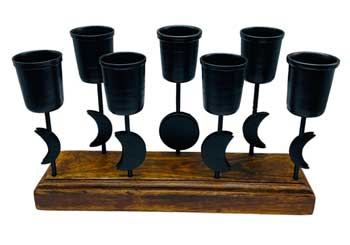
An iron candle holder on a stained wooden base that carries the phases of the moon and holds up to seven tapers, made for altars where the lunar cycle shapes the work.
Quick Uses
- Lunar Calendar: Light one taper for each phase as the month turns.
- Seven-Day Working: Burn one taper a night for seven nights toward one goal.
- Esbat Centrepiece: Light all seven together on the full moon.
How to Use It
Witchcraft & Folk Magick
- Light the tapers left to right across the waxing nights for a working that grows, and right to left on the waning nights to shrink a problem.
- Use it as the centrepiece of a coven esbat, with each member lighting one taper.
Hoodoo & Rootwork
- Run a seven-night candle working by lighting a new taper each night, set over the same petition paper under the base.
- Burn seven colours, one for each day of the week, in a long work for steady change.
Ceremonial & Occult Magick
- Assign a taper to each of the seven classical planets and light the one that rules the day before your planetary work.
- Use the full set as a light for lunar mansion or Moon-sphere rites.
Demonology & Black Magick
- Burn seven black tapers through the waning nights for a binding that tightens as the moon shrinks.
- Use the holder as a ring of offering lights before a spirit’s sigil on a dark-moon evocation.
A Simple Working
- Start on the night after the new moon.
- Seat seven white tapers in the holder.
- Write a single wish on a slip of paper and tuck it under the wooden base.
- Light the first taper, speak the wish, and let it burn for an hour before snuffing.
- Each night, relight the tapers already used and add one more.
- On the seventh night, let all seven burn down together.
- Burn the paper in the last flame and scatter the ash outside.
Pairs Well With
- White Taper Candles: Neutral tapers you can dress for any intention.
- Planetary Taper Set: For running a taper per planet or per day.
- Moon Water: To anoint the tapers before each night’s lighting.
- Selenite: A moon stone for the altar beside it.
What You Receive
One iron moon phases candle holder on a stained wooden base. Approximately 7 1/2″ wide and 5″ tall, holding up to 7 taper candles. Candles not included.
Origin & Lore
This is a candelabra-style holder, made to carry several tapers at once, with the phases of the moon set along it as both decoration and a guide for timing.
Timing work by the moon is very old. Medieval and early modern almanacs advised readers which phase suited planting, cutting hair and starting ventures, and the practice passed into folk magick as the rule that waxing moons build and waning moons remove.
The number seven runs through the same lore, from the seven classical planets to the seven days of the week named for them.
Did You Know?
The seven days of the week are named for the seven classical planets, which is why seven-light holders suit planetary work.
Related products