


Myrrh is the resin of endings: it embalmed the dead of Egypt, was brought to the infant Christ as a sign of his death, and was carried to his tomb.
Origin & Traditional Use
Myrrh is the resin of Commiphora trees from Arabia and the Horn of Africa. The Egyptians used it in embalming and temple incense, it is a principal ingredient of the holy anointing oil in Exodus, and it appears in the Gospels both among the Magi’s gifts and at Jesus’s burial.
Uses by Tradition
Witchcraft & Folk Magick
- Ancestor work: burn beside photographs and offerings to honour the dead.
- Pairing: burn with frankincense to deepen and steady a blessing.
- Grief: burn on the anniversary of a death while speaking to the person who has passed.
Ceremonial & Occult Magick
- Myrrh is the main resin in the Abramelin oil, used to anoint the magician and the oratory in that operation.
- Burned as a Saturnine and lunar incense in rites of mourning, binding and deep contemplation.
A Simple Working
- Set a glass of water, a white candle and a photograph of your ancestor on a cloth.
- Light the candle and light a myrrh stick from it.
- Hold the stick before the photograph and speak your ancestor’s name.
- Tell them what you are grateful for, and ask for their guidance.
- Leave the stick to burn in a holder beside the photograph.
- Pour the water outside on the ground the next morning.
Pairs Well With
- Frankincense: the classic partner resin.
- A white seven-day candle: for an ancestor altar.
- Myrrh resin: for charcoal burning.
- An incense holder: to catch the ash.
Lore & History
Ovid’s Metamorphoses tells of Myrrha, who was turned into a myrrh tree; the resin is her tears, and from the tree’s trunk the god Adonis was born. In the Qabalistic tables of Crowley’s 777, myrrh is assigned to Binah, the sphere of Saturn and the Great Mother.
What You Receive
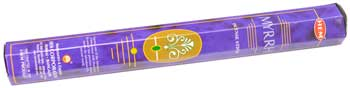
Myrrh incense sticks, available in a 20 pack, a 20 pack (pure), a hand-rolled 8 pack with visible resin and botanical grains, a 25 g pack, a premium 10 pack, or a box of 6 packs.
Did You Know?
The word myrrh comes from a Semitic root meaning ‘bitter’, as in Arabic murr, after the resin’s taste.
| Weight | N/A |
|---|---|
| Option | 20 pack, 20 pack (pure), 8 pack, 25 g, Premium, 10 pack, Box of 6 packs |
Related products


