

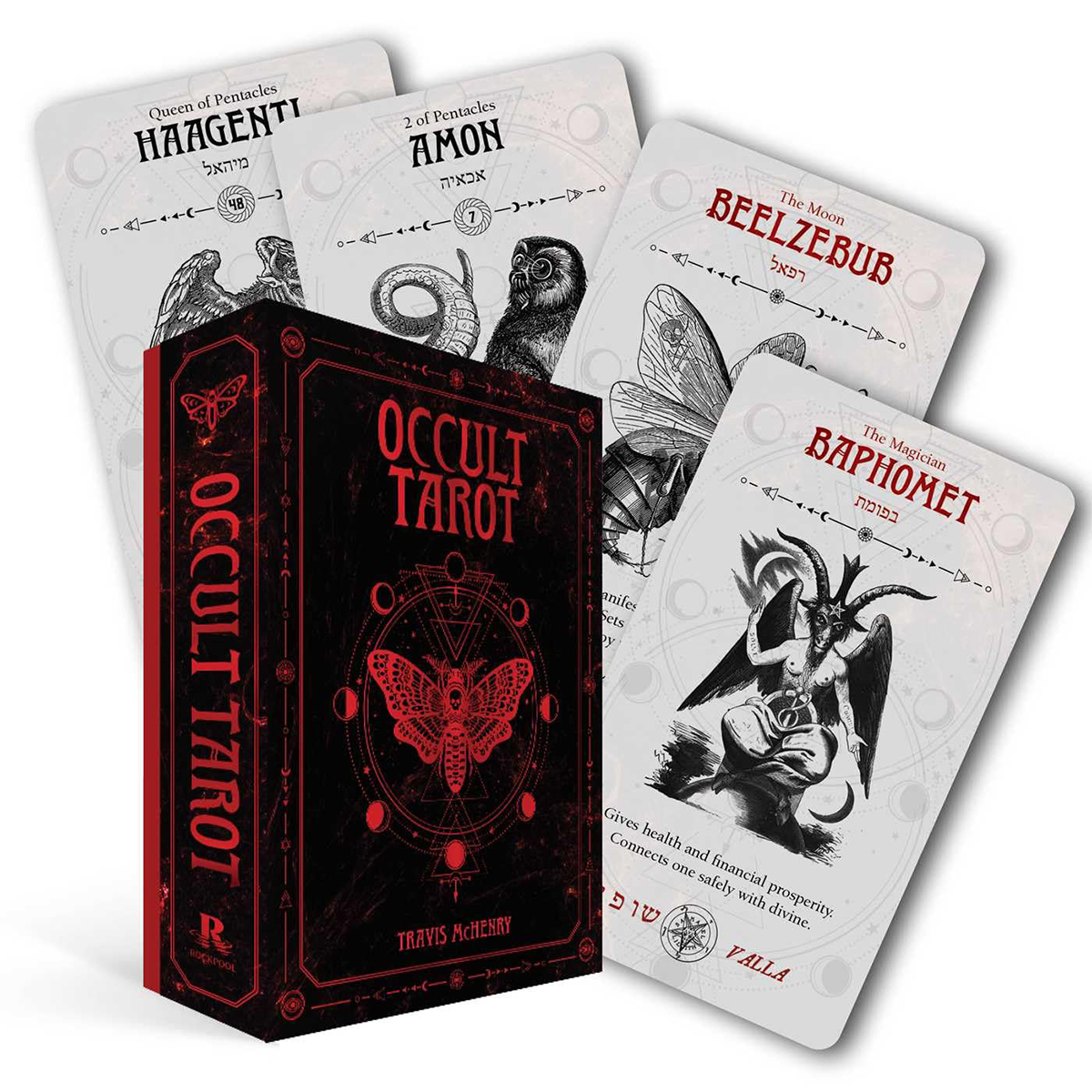
Occult Tarot by Travis McHenry
$32.95
Solomonic Daemons in 78 Cards
A 78-card tarot of daemons, symbols and sigils from the old grimoires, made by occultist Travis McHenry for readers who work with the Goetia.
Quick Uses
- Spirit choice: Draw a card to see which daemon is suited to the matter at hand.
- Sigil work: Use the card’s sigil as the focus for meditation or a charged seal.
- Before and after: Read before an evocation for timing and afterwards to see what was set loose.
- Shadow work: Draw a daily card to face one hidden part of yourself.
How to Use It
Demonology & Black Magick
- Choose the daemon for a working by drawing from the shuffled deck, then confirm with a second card.
- Ask a spirit to answer through the cards after the evocation, keeping the deck on the altar inside the circle.
- Lay the daemon’s card as the focal image of a pact, binding or hex working.
Ceremonial & Occult Magick
- Use the deck alongside the Key of Solomon to learn the spirits’ seals, ranks and offices.
- Place cards at the triangle of art during a Solomonic rite as a visual anchor.
Witchcraft & Folk Magick
- Read in the dark of the moon for banishing or cursing work.
- Keep a card by your bed to bring dreams of the spirit you study.
A Simple Working
- At night, light a black chime candle and burn a little dragon’s blood.
- Draw the circle you normally use and sit inside it.
- Shuffle the deck and ask which spirit should hear your petition.
- Draw one card and study the daemon’s sigil until you can see it with closed eyes.
- Draw a second card to see what that spirit asks in return.
- Record both cards and what you felt in your grimoire.
- Close the circle and snuff the candle.
Pairs Well With
- Dragon’s blood resin – a strong offering for spirit work.
- Black chime candles – quick lights for readings inside the circle.
- Goetic seal pendant – for wearing while working with the spirits.
- Blank grimoire – to log every reading and evocation.
What You Receive
One 78-card tarot deck of daemons, symbols and sigils drawn from old grimoires including the Archidoxis Magica and the Key of Solomon.
Origin & Lore
Tarot began as a fifteenth-century Italian card game and became a tool of divination in eighteenth-century France, later linked to the Kabbalah and ritual magick by the occult revival.
The Goetia, the first book of the seventeenth-century Lesser Key of Solomon, lists 72 spirits with their seals, ranks and offices. The Archidoxis Magica is a magickal text attributed to Paracelsus. McHenry draws on both to give each card its daemon and sigil.
Did You Know?
Johann Weyer printed a catalogue of 69 demons, the Pseudomonarchia Daemonum, as an appendix to his 1577 edition of De praestigiis daemonum, and much of the later Goetia follows it closely.
| Weight | 1.4 lbs |
|---|
Related products