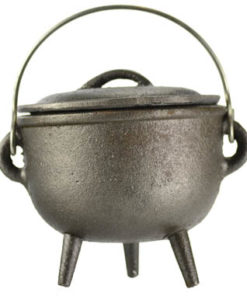


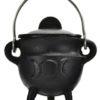

Pentagram cast iron cauldron
Price range: $13.15 through $76.95
A protective cauldron of the star · Available in 6 sizes
A black cast iron cauldron marked with a pentagram, used to burn incense, petitions and herbs in protective and banishing work.
Quick Uses
- Protection: burn rosemary, bay or frankincense on charcoal inside and carry it round the house, pentagram facing outward.
- Banishing: burn the name of a problem inside on a waning moon and scatter the ash beyond your boundary.
- Star smoke: burn incense under the cut-out lid so the smoke rises through the star.
- Pentagram rituals: set it at the centre of the circle with frankincense burning during the Lesser Banishing Ritual of the Pentagram.
How to Use It
Witchcraft & Folk Magick
- Protection incense: burn protective herbs such as rosemary, bay or frankincense on charcoal in the cauldron and carry it round the house, keeping the pentagram facing outward.
- Banishing papers: burn the name of a problem in it on a waning moon, then scatter the ash outside your boundary.
- Smoke through the star: in the lidded style with the cut-out pentagram, burn incense under the lid so the smoke rises through the star.
Ceremonial & Occult Magick
- Pentagram rituals: set it in the centre of the circle during the Lesser Banishing Ritual of the Pentagram with frankincense burning, as a focus for the traced stars.
- Consecration: suffumigate new tools, talismans and jewellery over the cauldron’s smoke before first use.
A Simple Working
- Line the cauldron with sand and set a lit charcoal disc on top.
- Sprinkle on a pinch of dried rosemary and a few grains of frankincense.
- Carry the cauldron by its handle or on a heatproof dish to the front door.
- Trace a pentagram in the air with the smoke and say “This house is guarded.”
- Repeat at each outer door and window.
- Return the cauldron to the altar and let the charcoal burn out.
Pairs Well With
- Charcoal discs: for burning resins and herbs.
- Frankincense: the classic resin for consecration.
- Rosemary: a traditional protective herb.
- Sand: to line the base.
What You Receive
Black cast iron cauldron with a pentagram design, available in 2 3/4″ with lid, 3″ with lid, 3 1/4″ cauldron/smudge pot, 3 1/2″, 4 1/2″ and 8″ with lid. Cast iron pieces vary slightly in finish.
Origin & Lore
This is a cast iron cauldron, the classic heat-holding pot of the hearth, cast with a pentagram on the body or cut through the lid. In modern witchcraft the pentagram stands for the four elements crowned by spirit and is the main symbol of protection, so a pentagram cauldron is often kept for warding, banishing and consecration.
Sir Gawain rode out to meet the Green Knight with a pentangle painted gold on his shield, each of its points standing for a virtue. The five-pointed star has been a sign of protection and wholeness for a very long time.
In the fourteenth-century poem Sir Gawain and the Green Knight, the poet spends two full stanzas explaining Gawain’s pentangle, calling it an “endless knot” and tying its five points to Gawain’s five senses, five fingers, the five wounds of Christ, the five joys of Mary and five knightly virtues. It is one of the most detailed medieval explanations of the symbol in English.
Did You Know?
The Pythagoreans of ancient Greece used the pentagram as a sign of recognition among themselves and associated it with health, labelling its points with the letters of the word hygieia.
| Weight | N/A |
|---|---|
| Option | 2 3/4" with lid, 3" with lid, 3 1/4" cauldron/smudge pot, 3 1/2", 4 1/2", 8" with lid |
Related products