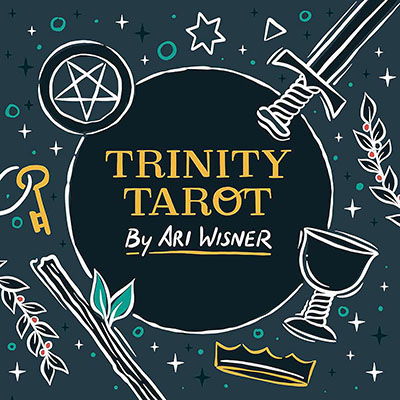

Trinity Tarot by Ari Wisner
$21.95
Concise Tarot, Renamed Courts
A 78-card tarot with clear, concise imagery and reimagined, genderless titles for several Majors and the court cards, made for beginners and seasoned readers alike.
Quick Uses
- Learn fast: Use the included prompt sheet of meanings to read from day one.
- Court clarity: Read the Apprentice, Champion, Keeper and Crown as stages of mastery.
- Daily draw: Pull one card each morning and check it against the prompt sheet.
- Quick reading: Use a three-card spread for fast answers when time is short.
How to Use It
Witchcraft & Folk Magick
- Read at the start of any spell to see how the work is likely to go.
- Lay a card that matches your intent beside a candle as its focus image.
Ceremonial & Occult Magick
- Read the renamed Majors, such as the Revealer and the Proclaimer, against their traditional titles to deepen your grasp of each.
- Use the court sequence of Apprentice to Crown as a map of your own progress in the work.
Demonology & Black Magick
- Read before and after an evocation for timing and outcome.
- Ask a spirit to answer through the cards after its offering.
- Divine which spirit to approach by drawing one card per candidate.
A Simple Working
- Light a white chime candle.
- Shuffle while asking where you stand in your practice.
- Draw one card from the court cards only.
- Read it as your stage: Apprentice, Champion, Keeper or Crown.
- Draw one more card from the full deck for your next step.
- Let the candle burn down and record the reading.
Pairs Well With
- A tarot cloth, for a clean reading surface.
- White chime candles, for short readings.
- Frankincense, for cleansing the deck.
- A blank journal, for tracking readings.
What You Receive
78 tarot cards and a prompt sheet of card meanings. Box approximately 3.63″ x 1.5″ x 3.63″.
Origin & Lore
Tarot was born as a card game in 15th-century Italy and became a divination tool in late 18th-century France. This deck keeps the 78-card structure but renames the court cards and several Majors with genderless titles: the Apprentice, Champion, Keeper and Crown; the Revealer, Proclaimer, Nurturer and Defender.
Renaming the cards is nothing new: early French and Swiss decks swapped the Popess and Pope for Juno and Jupiter, and Crowley renamed several trumps in his Thoth deck.
Did You Know?
The 15th-century Visconti-Sforza tarot cards, hand painted for the ruling families of Milan, are now scattered across collections including the Morgan Library in New York and the Accademia Carrara in Bergamo.
| Weight | 0.5 lbs |
|---|
Related products