


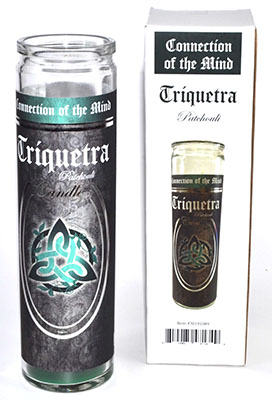
Triquetra 90-hour jar candle (patchouli)
$16.45
A Celtic knot flame for clarity
A patchouli-scented 90-hour jar candle with triquetra artwork, burned for clarity of mind, unbroken connection and protection.
Quick Uses
- Clear thinking: light it before study, writing or a decision that needs a settled mind.
- Bond work: burn it over three names written in the loops of a drawn triquetra to keep a family or coven tied.
- Protection: keep it burning at home during times of change as an unbroken boundary.
- Grounding: burn it at the close of a ritual as you return to ordinary awareness.
How to Use It
Witchcraft & Folk Magick
- Clear thinking: light it before study, writing or a decision that needs a settled mind.
- Bond work: burn it with three people’s names written in the three loops of a drawn triquetra to keep a friendship, family or coven tied together.
- Protection: keep it burning in the home during times of change, the circle around the knot serving as an unbroken boundary.
Ceremonial & Occult Magick
- Threefold invocation: use it in rituals that call on three powers at once, such as land, sea and sky, or past, present and future.
- Grounding: patchouli is a classic earthy scent; the candle suits the close of a ritual, when you return to ordinary awareness.
A Simple Working
- Draw a triquetra in a circle on paper and write one word in each of its three loops: what you know, what you are learning, and what you want to understand.
- Set the paper under the candle.
- Rub a drop of patchouli oil on your temples.
- Light the candle and read the three words aloud.
- Spend twenty minutes reading, writing or planning by its light.
- Snuff it and keep the paper in your notebook until the candle is spent.
Pairs Well With
- Patchouli oil: to dress yourself or the jar.
- Clear quartz: for clarity alongside the candle.
- A triquetra pendant: to carry the knot with you after the work.
- A blank journal: to record what comes to you by its light.
What You Receive
One patchouli-scented jar candle with triquetra artwork, approximately 90 hours of burn time, supplied boxed.
Origin & Lore
The triquetra, Latin for “three-cornered”, is a knot of three interlaced arcs, often set inside a circle. It decorates Insular manuscripts and Norse and Celtic metalwork, and later Christian art read it as the Trinity; modern pagans read it as maiden, mother and crone, or land, sea and sky. Patchouli, the scent here, is an earthy, grounding leaf oil from South and Southeast Asia.
The triquetra is drawn as one continuous line that crosses itself and never ends, which is exactly why monks, smiths and modern witches have all loved it.
Triquetra knots appear in the Book of Kells (around AD 800) and on carved stones and metalwork across early medieval Ireland, Britain and Scandinavia. In the 19th century, patchouli leaves were packed between Indian shawls shipped to Europe to keep moths away, and the scent became so associated with genuine Indian cloth that European weavers began scenting their imitations with it.
Did You Know?
The triquetra was stamped on the cover of the Book of Shadows in the television series Charmed (1998 to 2006), which did more than anything else to make it popular as a witch’s symbol.
| Weight | 1.8 lbs |
|---|
Related products


