Triquetra Hand-Tooled Leather Journal with Latch
$20.85
Celtic Knotwork, Handmade Paper
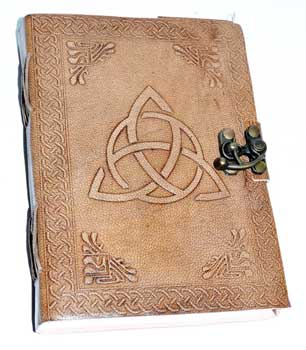
A hand-tooled 5″ x 7″ leather journal embossed with a triquetra and spiral knotwork, filled with 192 lined pages of handmade paper and closed with a latch, ideal for a book of shadows written in neat lines.
Quick Uses
- Book of shadows: Write spells and rituals on the lined pages for a clean, readable book.
- Threefold work: Divide the book into three parts: spells, rituals and journal.
- Protection: Trace the triquetra on the cover before each writing session.
- Herbal: Keep correspondences and recipes in tidy columns.
How to Use It
Witchcraft & Folk Magick
- Trace the triquetra with your finger at the start of each session as a small charm of protection over the book.
- Keep a sabbat section and note the date, weather and omens each year.
- Record moon phases, herb correspondences and the recipes that worked, so the book grows into your own tradition.
Ceremonial & Occult Magick
- Write out invocations and circle-casting texts so the book itself can be carried into the temple.
- Copy talismanic seals and planetary squares with care, then consecrate the pages along with the book.
Demonology & Black Magick
- Log every pact, petition and offering with the date and hour, and note what was promised on both sides.
- Design and refine sigils on its pages, and draw each spirit’s seal before an evocation.
A Simple Working
- Light a green candle and burn a little mugwort.
- Hold the book and trace the triquetra slowly three times.
- Name three things this book will hold: spells, wisdom, and work with spirits.
- Write those three on the first page.
- Close the latch and let the candle burn down.
- Keep the book wrapped in cloth when it is not on the altar.
Pairs Well With
- Mugwort: For blessing the book.
- Green candles: For a Celtic or earth-based dedication.
- Fountain pen: Lined handmade paper rewards good ink.
- Altar cloth: To wrap and protect the leather.
What You Receive
One hand-tooled leather journal with lined pages of handmade paper, 192 pages, latch closure, 5″ x 7″. Embossed with a triquetra and spiral knotwork. Border embossing may vary and size may vary slightly.
Origin & Lore
The triquetra, a three-pointed interlaced knot, is found on early medieval Irish and Northumbrian metalwork, stone crosses and manuscripts. Modern witches read it as maiden, mother and crone, or land, sea and sky.
A tooled leather blank book continues the old craft of bookbinding, where a book of personal knowledge was something made to last a lifetime.
Did You Know?
Triquetra knotwork appears in the Book of Kells, the Irish illuminated Gospel book made around 800 and kept at Trinity College Dublin.
| Weight | 1 lbs |
|---|
Related products