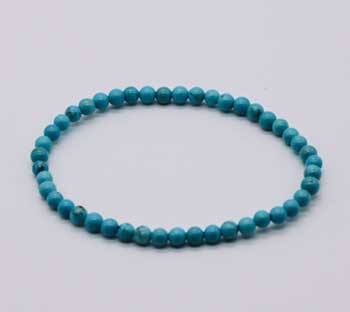
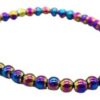
Turquoise Stretch Bead Bracelet (4mm)
$6.55
The Traveller’s Protective Stone
A stretch bracelet of 4mm turquoise beads, the sky-coloured stone carried across many cultures for protection, courage, luck and love.
Quick Uses
- Travel Ward: Wear it whenever you travel, as turquoise has long been a traveller’s stone.
- Lucky Wrist: Wear it on your dominant hand when you play cards or buy a ticket.
- Courage: Touch the beads and state your intention before speaking up.
- Love Token: Charge it and gift it to a partner as a sign of loyal affection.
How to Use It
Witchcraft & Folk Magick
- Charge it in daylight on a clear blue-sky day, asking for open roads and safe travel.
- Wear it as a protective amulet when riding or driving, as horsemen once did.
Hoodoo & Rootwork
- Dress the beads with Lucky Hand or Fast Luck oil before a game of chance.
- Keep it overnight in a dish with a bay leaf and a lodestone to feed its luck.
- Hang the bracelet over the rear-view mirror between wearings as a travel charm for the car.
Ceremonial & Occult Magick
- Work it as a Jupiter stone for fortune, laying it on a Jupiter talisman on Thursday.
- Wear it during invocations for open communication and clear speech.
Demonology & Black Magick
- Wear it as a personal protective charm during spirit contact.
- Offer it on the altar as a token of value when making a pact for luck.
A Simple Working
- On a Thursday, light a blue chime candle on a heatproof dish.
- Place the bracelet in front of the candle with a single bay leaf.
- Write the luck or courage you want on the bay leaf.
- Hold the bracelet and read the words aloud three times.
- Let the candle burn down, then burn the bay leaf in the dish.
- Wear the bracelet from that day as your lucky charm.
Pairs Well With
- Bay Leaves: For writing wishes during luck workings.
- Lodestone: To keep feeding the bracelet’s drawing power.
- Blue Chime Candles: For charging the beads with Jupiterian fortune.
- Lapis Lazuli: Another deep blue stone for courage and clear speech.
What You Receive
One stretch bracelet strung with 4mm turquoise beads.
Origin & Lore
Turquoise is one of the oldest known gemstones, mined in Sinai by the ancient Egyptians and prized in Persia, Tibet and the American Southwest. In Persia and Turkey it was set into horse bridles and worn as an amulet against falls and the evil eye, which is where its reputation as a traveller’s and rider’s stone comes from.
Its name comes from the French for Turkish stone, because it reached Europe through Turkish trade routes.
Did You Know?
The word turquoise comes from the French pierre turquoise, Turkish stone, after the trade routes that brought it to Europe.
Related products