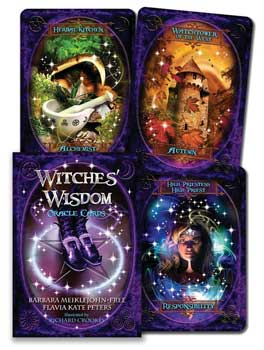

Witches’ Wisdom Oracle by Barbara Meiklejohn-Free & Flavia Kate Peters
$26.39
The Old Ways, In 48 Cards
A 48-card silver-gilded oracle drawing on the cunning folk, herbalists and seers of the Craft, with invocations in the guidebook that make it as much a ritual tool as a reading deck.
Quick Uses
- Invocation: Read the invocation printed for your drawn card aloud at the start of a working.
- Ancestor reading: Draw for guidance from the wise ones of your own line before an offering.
- Herb choice: Let the card’s theme point you toward which herb or element to bring into a spell.
- Moon spreads: Use the sample spreads from the guidebook on each full and new moon.
How to Use It
Witchcraft & Folk Magick
- Pull a card at the start of each sabbat and build your altar around its element or theme.
- Speak the card’s invocation as you light the candle for a spell, so the reading and the work flow together.
- Use a three-card spread to choose which herbs, stones and timing suit a working.
Ceremonial & Occult Magick
- Draw an elemental card for each quarter as you cast a circle and meditate on it before calling that direction.
Demonology & Black Magick
- Ask a familiar spirit or ancestor to answer through the deck once you have made your offering, drawing one card per question.
- Read before an evocation to judge whether the night is right, and again afterwards to see what the spirit left behind.
- Use a drawn card as the image you focus on while you speak a pact or petition.
A Simple Working
- Set a bowl of water and a white candle on your altar on the night of the full moon.
- Burn a pinch of mugwort on a charcoal disc and pass the deck through the smoke.
- Ask the wise ones of the Craft to speak, then draw three cards: past, present and the road ahead.
- Read each card’s entry and speak the invocation for the third card.
- Leave the cards laid out by the water until the candle has burned down.
- Pour the water at the foot of a tree in the morning as thanks.
Pairs Well With
- Mugwort: The classic seer’s herb for opening a reading.
- Moonstone: A Moon stone to rest on the deck between readings.
- White chime candles: Short, clean burns for invocation work.
- Book of shadows: Record which cards answered and what invocations you spoke.
What You Receive
One kit: a 48-card silver-gilded oracle deck and a guidebook with sample spreads, invocations and card meanings.
Origin & Lore
Before printed decks, village wise women and cunning folk read signs in tea leaves, playing cards, egg whites and the flight of birds. Oracle decks are a modern form of the same practice: pictures to prompt intuition and carry a message.
This deck is built around the healers, herbalists, teachers and seers its authors describe as custodians of the Craft, and pairs each card with a short invocation.
Did You Know?
England’s cunning folk were working as paid charmers, finders of lost goods and counter-witches well into the nineteenth century, and many kept handwritten books of charms.
| Weight | 1 lbs |
|---|
Related products



Crystal Balls