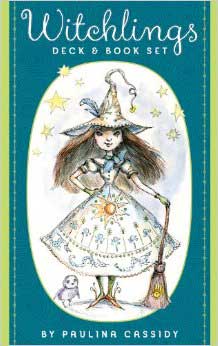
Witchlings Deck & Book by Paulina Cassidy
$25.25
Forty Witchlings, 150+ Spells
A 40-card deck and spell guidebook from Paulina Cassidy, where each little witch carries her own charm, ritual and piece of advice, which makes it a handy daily oracle and a ready-made spell bank in one box.
Quick Uses
- Daily draw: Pull one Witchling each morning and work the small spell she is paired with in the guidebook.
- Spell picker: Shuffle while holding your intention and let the card choose which charm you cast that night.
- Altar image: Stand a card on your altar as the focus for a week-long working on the same theme.
- Teaching deck: Use it with newer practitioners to build a habit of pairing divination with practical spellcraft.
How to Use It
Witchcraft & Folk Magick
- Draw a card before a candle or jar spell and adapt the Witchling’s suggested charm to your own herbs and tools.
- Keep a card in your pocket or purse for the length of a working as a reminder of the intention you set.
- Lay a three-card spread at each new moon and plan the month’s small spells from what comes up.
Ceremonial & Occult Magick
- Use the deck for a quick reading before you open a circle, so you enter the rite with a clear question.
- Write the Witchling’s name and theme into your ritual notes as a correspondence alongside the planetary hour.
Demonology & Black Magick
- Read before and after an evocation to check what has shifted, and keep the two spreads side by side in your records.
- Ask a spirit you already work with to answer through a single drawn card when the session is closing.
- Lay one card face up beside a seal as the focal image of the working, chosen to match what you are petitioning for.
A Simple Working
- Light a white tealight and a stick of frankincense on a cleared table.
- Shuffle the deck slowly while stating out loud the single thing you want help with.
- Draw one card and read its entry in the guidebook, including the spell attached to it.
- Gather what that spell needs, substituting your own herbs where it makes sense.
- Work the spell while the card stands upright against the candle holder.
- Let the tealight burn out, then record the card, the spell and any results in your journal.
Pairs Well With
- White tealights: Simple, quick light for the short charms the guidebook teaches.
- Frankincense resin: A clean, all-purpose smoke for clearing the deck before a reading.
- Blank spell journal: Somewhere to log which Witchlings appear and how their spells worked for you.
- Tarot cloth: Gives the deck a dedicated reading surface on the altar.
What You Receive
One boxed set: a 40-card deck and a 204-page illustrated guidebook with instructions for more than 150 spells. The card stack measures 5″ x 3″ x 1/2″.
Origin & Lore
Oracle decks grew out of the same impulse as tarot and Lenormand: a set of images that can be shuffled, drawn and read as answers. Unlike tarot, an oracle has no fixed structure, so each artist builds her own system, and here every card is a character with a spell attached.
Paulina Cassidy is known for her whimsical, finely detailed illustrations, and this set gives each of her 40 Witchlings a name, a personality and a piece of practical craft.
Did You Know?
The earliest surviving tarot cards are the hand-painted Visconti-Sforza decks made for the ruling families of Milan in the mid-1400s; they were luxury game cards long before anyone read them for divination.
| Weight | 0.8 lbs |
|---|
Related products

Altar Supplies