



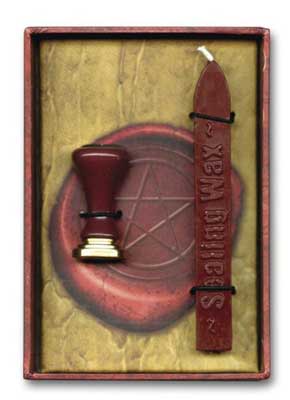

Magick Sealing Wax and Seal Kit
$20.85
Seal your spells with fire and wax
A boxed kit of natural wax and a metal seal for closing petitions, letters and spell papers.
Quick uses
- Petitions: seal a folded petition to lock in its intent.
- Letters: close ritual letters to spirits or deities.
- Grimoire: mark finished pages or charms with your seal.
How to Use It
Witchcraft & Folk Magick
- Sealing wax was the way letters and legal documents were closed and authenticated for centuries; in witchcraft the seal becomes a binding, the moment a working is closed and made fast.
- Fold a petition paper toward you to draw something in, away from you to send it off, then seal the fold with wax.
Ceremonial & Occult Magick
- Ceremonial practitioners seal talismans and spirit letters, impressing their own mark as a signature of authority. Use the metal seal as your personal stamp on every written working.
- Perform the sealing in the planetary hour that rules your working.
Demonology & Black Magick
- Practitioners who write pacts or petitions to spirits seal them with wax before burning or burying, marking the agreement as complete.
- Drip wax over a name paper to bind a target in place.
A Simple Working
- Write your petition or intention on clean paper.
- Fold it three times, toward you to draw in or away to send off.
- Melt a little wax over the fold.
- Press the metal seal into the wax and say, “It is sealed.”
- Keep, burn or bury the sealed paper as your working requires.
Pairs Well With
- Parchment paper: for petitions and spirit letters.
- Dragon’s blood ink: a traditional ink for spell writing.
- Taper candles: to melt the wax at your altar.
- Spell bottles and jars: to hold sealed papers.
- Dressing oils: a drop on the paper before sealing.
What You Receive
A boxed kit (3 1/8″ x 4 1/2″) with natural wax and a metal seal.
Origin & Lore
Seals and signet rings were used in the ancient world to mark ownership and authority, and wax seals closed letters and charters across medieval Europe. A broken seal showed a letter had been opened.
In ritual, the same act of closing and marking carries over: the seal declares a working finished and owned by its maker.
Did You Know?
Before written signatures were common, an impression from a personal seal matrix served as legal proof that a document came from its owner.
Related products




